
Why your rack design must change when the environment changes
Most pallet racking is designed for a fairly predictable environment: indoors, dry, and protected from wind. The moment you move that same structure outside in a yard, under a canopy, or inside a cool room or freezer, the rules change.
Corrosion, wind loads, slab conditions, condensation and ice all affect how pallet racking for cool room and outdoor applications must be designed, coated, anchored and maintained. Get it wrong, and you’re not just shortening the life of the rack – you’re risking compliance with AS 4084 and the structural safety of your warehouse.
This article walks through what actually changes when you’re designing racking for:
-
Outdoor yards and under-cover external areas
-
Chillers, cool rooms and freezers
-
“Hybrid” spaces (half inside, half outside, or openings directly to the weather)
…and how Better Storage Systems approaches these environments when we design and install AS 4084–compliant pallet racking for Australian warehouses.
Outdoor pallet racking: not just “the same rack outside”
1. Corrosion and coatings: powder coat vs galvanised
Standard warehouse racking is usually supplied with:
-
Powder-coated frames and beams – ideal for general indoor use, low to moderate humidity, and minimal chemical exposure.
-
Zinc-plated hardware – bolts, anchors and clips with a basic protective coating.
Once you move outside, things become harsher: UV, driving rain, pooled water on the slab, airborne salts (especially near the coast) and industrial pollutants. Corrosion accelerates and can attack uprights, bracing, connectors and base plates, reducing capacity long before the rack looks “obviously rusty”. AS 4084:2023 now explicitly expects corrosion to be assessed as part of pallet racking inspections.
Typical outdoor options include:
-
Hot-dip galvanised frames and/or beams
-
Thick zinc coating that protects even if scratched.
-
Good for fully exposed yards and coastal locations.
-
-
Pre-galvanised components plus powder coat
-
Extra protection in splash zones or semi-exposed environments.
-
Often used under canopies with occasional wetting.
-
-
Stainless or higher-grade fixings
-
For particularly aggressive environments, chemical plants or near marine spray zones.
-
The right coating strategy depends on:
-
How exposed the rack is (fully outside, partly under cover, or fully enclosed cool room)
-
Distance from the coastline and local industrial exposure
-
Required design life of the installation
Better Storage Systems can design pallet racking systems for industrial warehouses with the appropriate coatings and finishes – not just standard indoor racking – so the structure keeps its capacity for the life of the asset, not just the first few years.
2. Base plates, anchors and slab checks outdoors
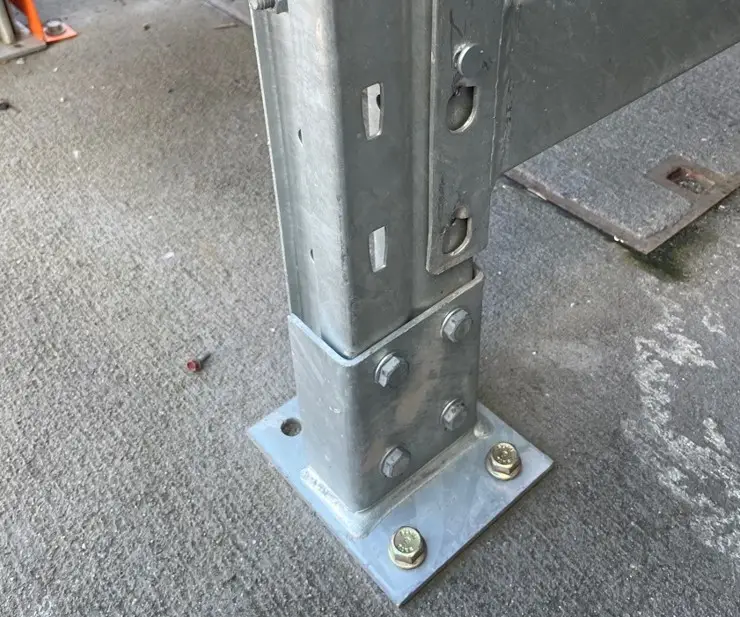
Indoors, your racking is mostly dealing with vertical loads: pallets, occasional impact and minor sway. Outside, wind adds horizontal load and uplift – which puts much more demand on base plates, anchors and the slab. The details matter.
Key differences for outdoor racking:
-
Anchor quantity and quality
-
SafeWork guidance for pallet racking in Australia expects at least two anchors per footplate as a baseline, with suitable capacity and embedment depth.
-
Outdoor racks may require higher-capacity anchors or more conservative spacing to resist uplift and overturning under wind.
-
-
Slab verification
-
For outdoor yards, the existing slab or hardstand may not have been designed with racking loads in mind.
-
Better Storage Systems’ quotations typically assume the slab is structurally adequate and not compromised by joints, tendons or services – and recommend independent verification where there’s uncertainty.
-
-
Edge distances and joints
-
Anchors must be kept clear of slab edges, step-downs and saw-cuts to avoid concrete breakout or cracking under load.
-
Poorly positioned anchors at the edge of an apron are a common failure mode in outdoor yards.
-
In short: when we design outdoor pallet racking, we don’t just “add more dynabolts”. We check the slab assumptions, specify suitable anchors and base plates, and align everything with AS 4084 design requirements.
3. Wind loads, canopies and open-front sheds
Indoors, the building itself shelters your racks from direct wind pressure. Outdoors, or under open-front canopies, your racking becomes a wind-loaded structure in its own right.
Australian structural design uses AS/NZS 1170.2:2021 – Wind actions to determine site wind speeds and pressure on structures, including components like racking exposed to the weather.
For outdoor or semi-outdoor racking, that means:
-
Regional wind zone and terrain category matter (e.g. coastal industrial vs sheltered urban).
-
The rack’s height, aspect and exposure drive the wind pressure on frames, pallets and any cladding/roofing above.
-
Designers must consider overturning, uplift and sway – not just vertical loads.
In practice, this leads to design decisions such as:
-
Larger or thicker uprights and bracing patterns in exposed locations.
-
Additional bracing bays, tie-backs or connections to building columns where appropriate.
-
Conservative top-beam levels to control sway and deflection under wind.
If you’re planning outdoor racking, the safest approach is to treat it as a structural project – not a “bolt-together kit”. That’s where a dedicated pallet racking specialist like Better Storage Systems, working to AS 4084 and the relevant wind standards, becomes essential.
Pallet racking for cool rooms, chillers and freezers
Cool rooms and freezers feel like “indoor” spaces – but from a racking perspective, they behave more like a special environment with their own risks: very low temperatures, condensation, ice, aggressive defrost cycles and hygiene requirements.
1. Temperature, condensation and the right coating system
In temperature-controlled storage, racking components are exposed to:
-
Repeated freeze–thaw cycles when doors open or during defrost
-
High local humidity near evaporators and doorways
-
Wash-down chemicals and cleaning routines
This combination can cause hidden corrosion at welds, base plates and connection points if the coating system isn’t appropriate.
Typical strategies for pallet racking for cool room and cold storage include:
-
Galvanised or duplex-coated frames in high-moisture zones (e.g. near evaporators or entrances).
-
Sealed or galvanised base plates and anchors to protect the interface between steel and slab.
-
Durable powder coats rated for low temperatures, where a clean, non-galvanised finish is preferred for aesthetics or hygiene.
Because cold storage pallets are often very dense (frozen food, liquids, proteins), your beams and frames may be working harder than in an ambient warehouse. The design must factor in both high loads and the harsher environment – not one or the other.
2. Slabs, vapour barriers and anchoring in cold stores
Cold-storage floors are often more complex than standard warehouse slabs. They may include insulation layers, vapour barriers and heating systems to prevent frost heave.
When we design pallet racking installation for cool rooms:
-
We confirm whether anchors can penetrate the cold-store slab without damaging insulation, vapour barriers or refrigeration pipes.
-
In some builds, racking must be anchored into the structural slab below the insulated layer using specially designed fixings.
-
Edge distances and joint locations are even more critical, as movement at slab joints can be amplified by temperature changes.
This is one area where early collaboration between your builder, refrigeration contractor and racking designer saves enormous time and cost. Retro-fitting compliant anchors into a finished cool room can be far more expensive than getting the design right upfront.
3. Load ratings, deflection and signage in cold environments
AS 4084 sets expectations for beam deflection, frame stability and maximum bay loads, regardless of whether the rack is in ambient or cold storage. What changes in cool rooms is how closely you need to manage live loads and operator behaviour.
Good practice for pallet racking in cold rooms includes:
-
Higher safety margins on load capacity where pallets are extremely dense or variable.
-
Load signs that clearly reflect cold-storage conditions – including bay load, beam load and pallet type. Better Storage Systems has a dedicated resource on pallet racking load signs and what must be shown on the board.
-
Operator training to avoid impact damage in tight, often low-visibility cold environments.
Better Storage Systems’ pallet racking audits and inspections help you verify that cool-room and freezer racking remains compliant over time, especially where corrosion or impact is more likely.
Can you move existing indoor racking outside or into a cool room?
It’s tempting to relocate surplus indoor racking into a yard or chiller to save CAPEX. In some cases it can be done, but only after it has been re-assessed and recertified for the new conditions. Common mistakes include:
-
Re-using standard powder-coated frames outdoors with no corrosion allowance.
-
Ignoring wind when moving racks into an open-front shed or yard.
-
Using indoor-grade anchors that are undersized, incorrectly embedded or too close to slab edges for outdoor loads.
-
Modifying frame bracing or cutting down frames on site without updating engineering calculations.
-
Mixing brands and components, which can invalidate capacity calculations and AS 4084 compliance.
If you’re relocating or reconfiguring racking, it’s safer – and often cheaper long-term – to have a specialist review the design, re-run capacities and issue updated load signs rather than relying on “it’s always been fine”.
How Better Storage Systems approaches harsh environments
Whether you’re planning pallet racking for cool room, outdoor yard storage or a mix of both, Better Storage Systems can design, supply and install systems that are suited to the environment – not just the drawing.
Our process typically includes:
-
Environment and risk assessment
-
Ambient, chilled, frozen or fully outdoor?
-
Exposure to rain, wind, chemicals and wash-downs?
-
Coastal, industrial or sheltered location?
-
-
System selection and layout
-
Choosing the right racking type (e.g. selective pallet racking, drive-in, mobile racking for dense cold storage, etc.).
-
Designing aisle widths, beam levels and bay configurations to suit your product and MHE.
-
-
Coatings and materials
-
Specifying galvanised or duplex coatings where needed.
-
Selecting appropriate hardware and anchors for outdoor or cold environments.
-
-
Structural design and compliance
-
Designing to AS 4084 and relevant structural actions (including wind for outdoor applications).
-
Providing load signs and documentation that match the installed configuration.
-
-
Professional installation and ongoing support
-
Using experienced racking installation teams familiar with outdoor and cool-room work.
-
Ongoing pallet racking audits to monitor impact damage, corrosion and structural changes over the life of the system.
-
If you’re considering outdoor or temperature-controlled racking, the safest next step is to get a tailored design and quote. Better Storage Systems specialises in pallet racking for industrial warehouses, including cold storage and exposed yards, and can help you balance capacity, durability and compliance from day one.