
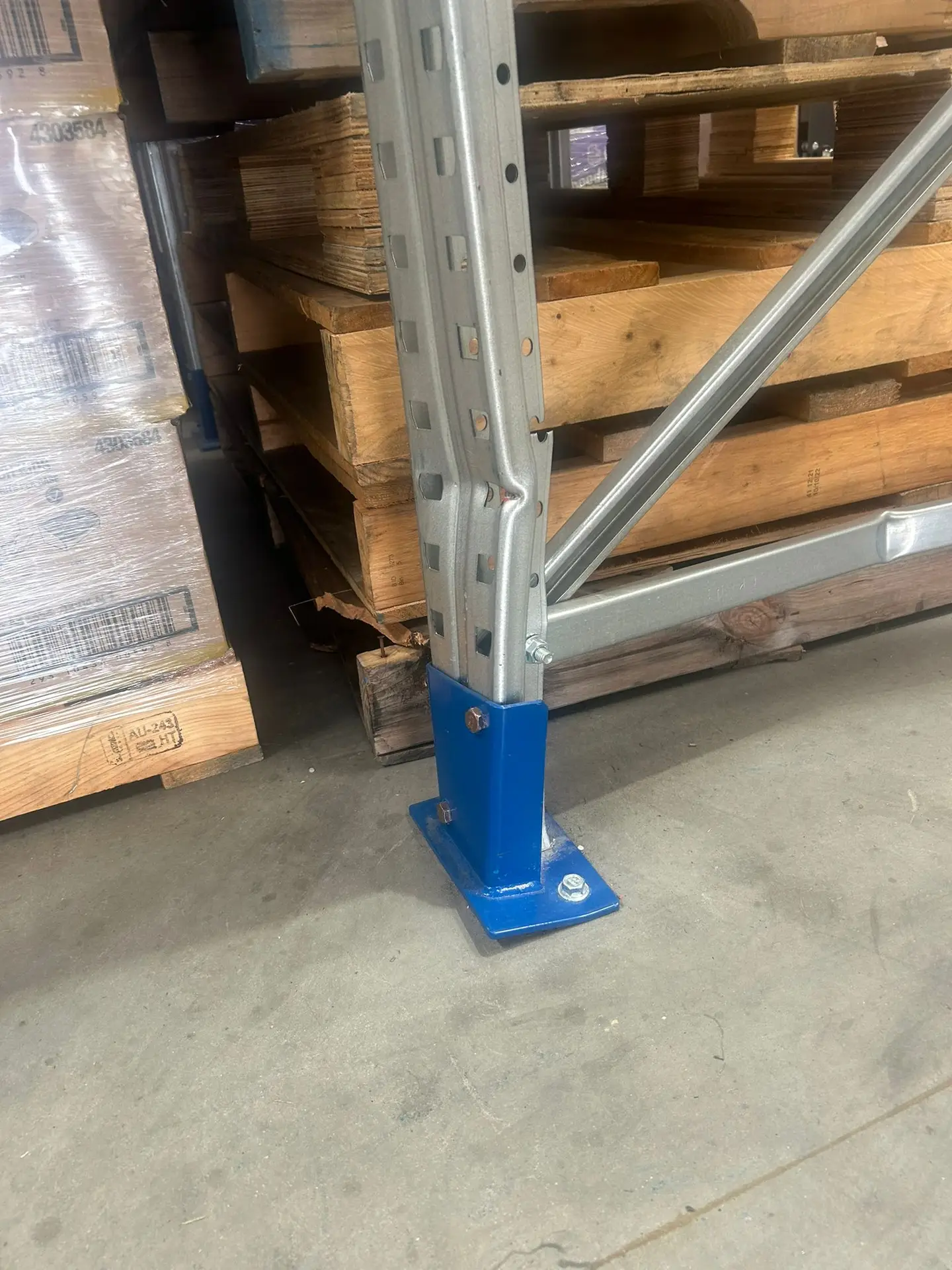
Warehouse managers and business owners often rely on a simple visual check — “the beam still sits, it still holds” — after a forklift nicks a beam or a pallet clips a connection. But pallet racking is a structural system, and small local damage to clip tabs, hooks or beam end connectors can quietly reduce load capacity, compromise beam-to-upright connections and turn a ‘minor bump’ into a catastrophic failure. This guide explains what to look for, why apparently minor damage matters, and the practical steps you should take to protect people, stock and your bottom line.
Why clip tabs, hooks and connectors matter
Beam end connectors, clip tabs and safety hooks are the small parts that do the heavy lifting of transferring load from beam to upright. They’re intentionally narrow and highly stressed components — which makes them vulnerable to concentrated impact and deformation.
-
A bent clip tab, crushed hook lip or twisted connector lug changes how the beam sits in the upright slot and how the load is carried.
-
Even if a beam still sits in place, connector deformation can reduce the effective engagement depth and change the load path, increasing stress on remaining material.
-
International and Australian standards highlight impact and beam damage as primary inspection concerns: regular inspections specifically call out beam damage and beam-to-upright connections as critical items to assess and repair (see guidance on damage and inspections).
Practical takeaway: the connection is the structural weak point. Never judge safety by whether the beam “still sits” alone.
How damage reduces capacity (even when it “still holds”)
Manufacturers’ manuals and standards show real-world consequences:
-
Forklift knocks that dent or crease a beam end or clip tab can reduce a beam’s load capacity by a significant percentage. One example in an installer manual reported damage from forklift impacts producing a 30–40% reduction in load carrying capacity in tested cases.
-
Standards for storage systems emphasise that beam strength requirements are separate from deflection limits. A beam may still meet deflection limits but have its strength degraded by local damage — which means collapse risk remains even when deflection looks acceptable.
Put simply: visible seating ≠ structural integrity. Local deformation concentrates stress and can lead to premature failure under design loads or during dynamic events (forklift impact, uneven loading).
Common types of beam/connector damage to watch for
H3 — Clip tabs and hooks
-
Bent or twisted tabs — reduce engagement in the upright slot.
-
Cracked or fractured hooks — partial fractures can suddenly propagate under load.
-
Worn or rounded hook lips — reduce mechanical interlock and can allow slippage.
H3 — Beam ends and connectors
-
Local denting or creasing at the end connector — often caused by a side impact from a fork tine or pallet.
-
Sheared tabs or missing safety locks — compromises the fail-safe that prevents beam disengagement.
-
Corrosion combined with deformation — reduces capacity more than either issue alone.
H3 — Upright slot and locking features
-
Damaged upright slots — damage to the upright at the slot area can prevent correct engagement of the safety lock or connector and must be remedied by repositioning the beam or replacing the upright if necessary.
Inspection rules of thumb for warehouses
Follow a risk-based, documented inspection program — but until that’s in place, use these practical checks after any impact event:
-
Stop using the affected bay until a competent person inspects it.
-
Document the damage (photos, date/time, forklift operator, load in bay).
-
Measure engagement — confirm the beam end connector is fully engaged in an undamaged slot (not just “lying in”).
-
Check clip tabs and hooks for bends, cracks, rounded edges or missing material. Use a straight edge or feeler gauge if needed.
-
Inspect upright slots above and below the beam for distortion or groove deformation.
-
Assess for permanent deformation — visible creasing, buckling or non-reversible twist usually means replacement is required.
-
Consider load testing only as a last resort, and only performed by an engineer, because passing a static test doesn’t guarantee long-term safety.
Standards and manufacturer manuals emphasise frequent, systematic inspections as a damage-reduction measure — and that permanent deformation is an indicator of overload or impact that requires replacement, not repair.
When “it still holds” is NOT good enough — three scenarios
1. Visual seating, hidden weakness
A beam appears seated but the clip tab is bent inward. The beam’s full engagement length is reduced and the connector carries more shear per unit area — reducing the allowable working load.
2. Repeated minor impacts
Small dents over time — e.g., repeated pallet collisions — cause work-hardening and stress concentrations. The connection may fail suddenly under a load it previously carried with margin.
3. Safety-lock damage
If the safety lock or pin hole at the top of the upright is damaged, the lock may not engage or may shear under load. Repair or reposition the beam immediately; do not rely on the beam remaining located by friction alone.
Practical repairs and management steps
-
Replace, don’t “tweak”: Minor straightening of a bent tab may be tempting, but it creates residual stresses and local weakening. Replace damaged beams, connectors or clips with manufacturer-specified parts.
-
Use OEM or equivalent rated parts: Only use parts rated and specified for your racking system and load levels.
-
Safety locks and pins: Fit missing or damaged locks immediately. These are cheap sacrificial parts compared to the cost and risk of a beam fall.
-
Upright protection: Install upright guards/column protectors to prevent the most common impact damage from forklifts.
-
Operator training: Most damage is human-driven — invest in driver training, pallet quality controls and safe stacking practices.
-
Document incidents and track recurring damage locations to inform layout, traffic management and protective device placement.
Manufacturer manuals and standards all point to replacement and engineered assessment when permanent deformation is present — and to planned inspection regimes as the primary mitigation measure.
Creating an effective inspection & response plan (sample checklist)
-
Immediate: Tag and isolate the affected bay after any impact; remove loads if safe to do so.
-
Short term (same shift): Competent inspector checks connectors, clip tabs, upright slots, locks and paints/finish for cracking or distortion.
-
24–72 hours: Replace any bent or cracked components; reposition beam to undamaged slot where allowed by manufacturer guidance.
-
Quarterly/biannual: Scheduled racking inspection by a qualified provider with a report and recommended repairs.
-
Annually: Structural audit by an engineer for high bays, high throughput or where repeated damage is logged.
Standards emphasise both routine inspection frequency and that inspection findings should feed into a damage reduction procedure and repair plan.
Final word: Don’t gamble on “it still holds”
A beam that’s merely sitting in place after an impact is not a guarantee of safety. Clip tabs, hooks and beam connectors are small but critical — and once deformed, they can meaningfully erode the strength and safety of your racking system. The cost of replacing a damaged component and tightening operational controls is small compared with the human, legal and financial cost of a racking collapse.
If you’re unsure about damage you’ve observed, have a qualified rack inspector or engineer assess the bay, replace compromised parts and document the repair. Investing in inspections, protection and training protects people, stock and continuity of your operations.
Need help?
If you’d like a formal pallet racking inspection, repair quote or advice on upright protection and safety locks, consider scheduling an expert inspection or repair service tailored to your racking type and throughput.