
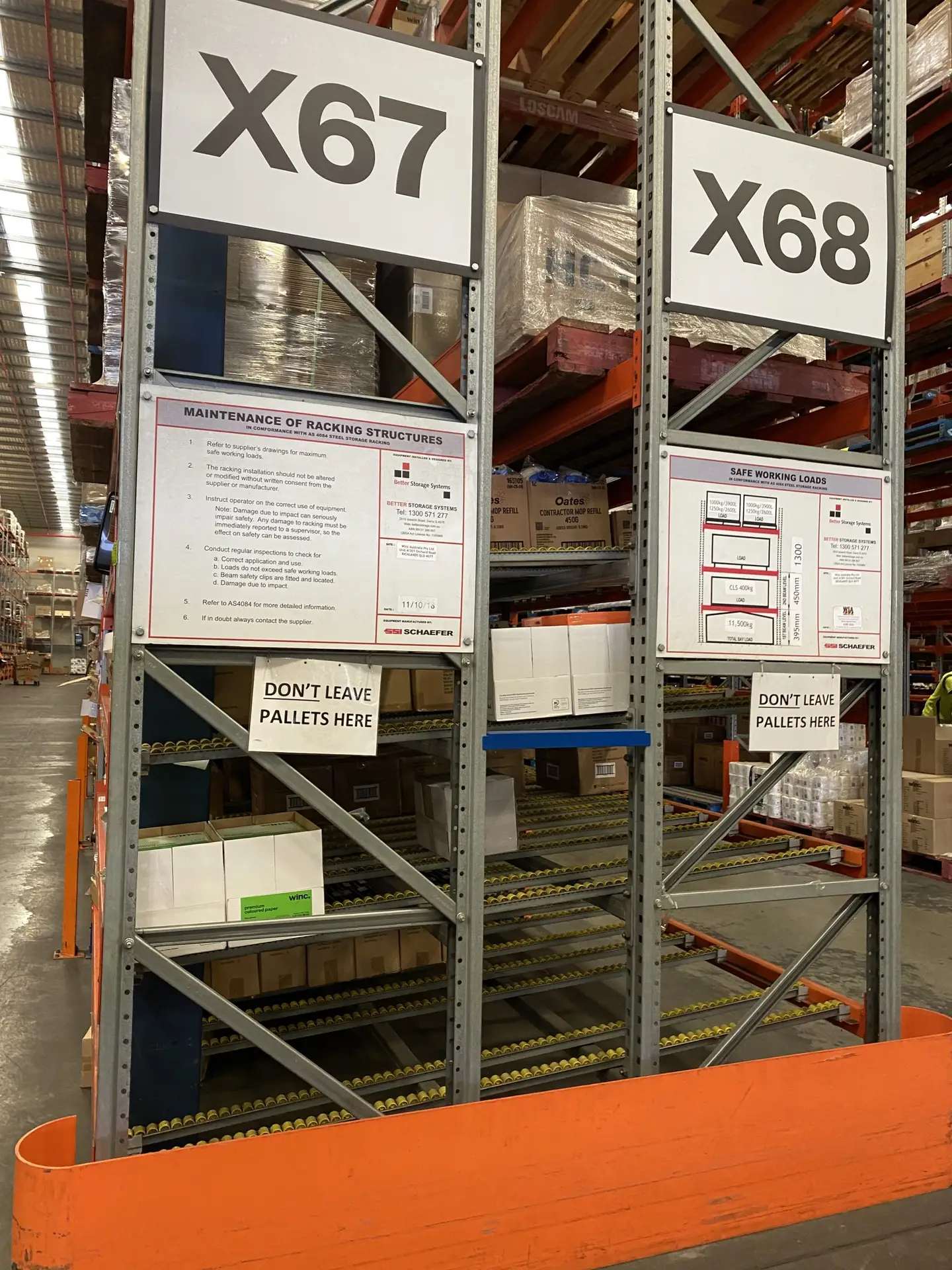
Why Pallet Racking Load Signs Matter More Than You Think
In most warehouses, pallet racking load signs are either an afterthought… or an argument.
-
“Can we put heavier pallets there?”
-
“Has anyone checked if that load sign is still correct?”
-
“We moved those beams last year – is this still compliant?”
Under AS 4084:2023, pallet racking is classified as plant/structure, and you have a duty to ensure it’s safe and used within its design limits. Load signs are how you communicate those limits clearly to every operator, on every shift. SafeWork NSW
Done properly, pallet racking load signs:
-
Prevent overloading by making capacity obvious at a glance.
-
Demonstrate your compliance with Australian pallet racking safety standards.
-
Support your pallet racking inspections and audit trail.
-
Reduce downtime, damage and the risk of collapse.
Done poorly—or not at all—they become one of the fastest ways for a warehouse to fail an inspection or end up on the wrong side of a safety incident.
This guide breaks down exactly what must be on a pallet racking load sign, why each field matters, and how CEOs, owners and warehouse managers can remove the guesswork for good.
What AS 4084 Actually Expects From Your Load Signs
AS 4084 (Steel Storage Racking) sets out minimum requirements for load signage on pallet racking in Australia. Although the full standard is licensed content, state regulators summarise the key obligations clearly. WorkSafe Tasmania
1. Where and How Load Signs Must Be Installed
Australian guidance based on AS 4084 specifies that each racking installation must have:
-
Permanent, corrosion-resistant plaques (typically metal or durable plastic).
-
Mounted in conspicuous locations – usually at the end of each racking run where operators enter the aisle.
-
Fixed mechanically to the racking, not just cable-tied to mesh or fencing.
-
Readable from ground level, with clearly legible text (state guidance often references minimum sign size and font height so they can be seen from a distance).
Better Storage Systems’ own inspection guide reinforces that load signs must be visible, legible and present on every pallet racking installation.
2. The Critical Capacity Numbers Every Sign Must Show
Across AS 4084 and regulator guidance, three capacity values come up consistently:
-
Maximum unit load
-
The maximum weight of a single pallet, including the pallet itself and product.
-
If your sign says 1,000 kg unit load, no pallet on that system should exceed 1,000 kg—regardless of how strong the beams “look”.
-
-
Maximum level (or beam) load
-
The maximum total load on one beam level (all pallets combined on that pair of beams).
-
Example: 3 pallets × 800 kg each = 2,400 kg. If your maximum level load is 2,400 kg, adding a fourth pallet—even if there is space—breaks compliance.
-
-
Maximum bay load
-
The total allowable load in one bay, across all beam levels supported by the same pair of frames.
-
This figure protects the frames themselves; overloading here can cause upright and bracing failure rather than beam deflection.
-
Better Storage Systems also highlights that load signs should clearly state max pallet, level and bay capacity, so your team can’t confuse one with another.
3. Design and Identification Details (Often Overlooked)
To be considered compliant, load signs should do more than just list weights. Guidance based on AS 4084-2012/2023 expects the sign to also show:
-
Designer’s name or company (the engineer or supplier responsible for the load calculation).
-
Racking manufacturer and/or supplier.
-
Customer/site name and location.
-
Installation date (or date of certification).
-
Maximum height from floor to first beam.
-
Maximum distance between first and second beam levels (because load capacity changes as beam spacing changes).
Some systems also document:
-
Beam profile or section (to match technical data).
-
Design or drawing reference number.
These fields create a direct link between the sign, the engineering calculation and the physical racking you are standing in front of. If something goes wrong, or if you are audited, this is exactly the information an inspector will look for.
How to Read a Load Sign (and Explain It to Your Team)
Most operators will only see a rectangle of numbers and jargon. As a leader, your job is to make sure everyone understands what those numbers mean.
A typical pallet racking load sign for a selective pallet racking system in Brisbane might include fields like:
-
Maximum pallet load (unit load) – per pallet, including product.
-
Maximum load per level – total across one beam level.
-
Maximum bay load – total across all levels in that bay.
-
Beam heights – the allowable configuration (e.g. first beam at 1,500 mm, second at 3,000 mm).
-
Configuration sketch – a simple diagram showing beam levels and number of pallets per level.
-
Racking supplier/engineer and installation date.
For toolbox talks or inductions, you can frame it in three simple questions:
-
“How heavy can each pallet be?” → Maximum pallet load.
-
“How much weight can we put on one shelf level?” → Maximum level/beam load.
-
“How much weight can live in this bay in total?” → Maximum bay load.
If your team can confidently answer those three questions by looking at the sign, you’re already ahead of many warehouses.
Common Load Sign Mistakes We See in Australian Warehouses
Even in sites with regular pallet racking safety inspections, the same load sign issues show up again and again. Industry inspection specialists and safety regulators list these as some of the most frequent non-compliances.
1. No Signs, or Only on Some Runs
-
New racking installed with no load signs at all.
-
Signs on the “main” aisles, but missing in secondary or high-bay zones.
-
Signs fitted to longspan or non-pallet systems but not to core pallet racking.
Under AS 4084, every racking installation must be clearly labelled, not just the sections that are easy to see from the office.
2. Old Signs Left in Place After Reconfiguration
This is extremely common:
-
Beams moved to create extra clearance for taller loads.
-
Additional beam levels added or removed.
-
Sections converted from standard selective to a different layout.
If the beam positions change but the sign does not get updated, the load ratings on that sign are no longer valid. Several guidance notes explicitly state that signage must match the current configuration, and changes require approval from the supplier or a competent engineer.
3. “Guesswork” Capacities and Handwritten Changes
We still see load signs where someone has:
-
Rounded capacities up “because the steel looks heavy-duty”.
-
Written new numbers over the original print with a marker.
-
Copied capacities from another site with different beam sections.
AS 4084 and manufacturer user guides are clear: only racking suppliers or qualified engineers can determine load ratings.
Guessing or editing figures on the board is a fast way to become non-compliant—and potentially personally liable—if something fails.
4. Signs That Are Damaged, Hidden or Impossible to Read
Examples include:
-
Stickers faded by UV in external or cold-room environments.
-
Signs hidden behind stock, stretch-wrap, bollards or mesh.
-
Text too small to be read from a forklift seat.
Regulators emphasise that signage must be durable, corrosion-resistant and easy to read in normal operating conditions.
5. Mixed Systems Using One Generic Sign
Where a warehouse has different systems (e.g. selective pallet racking, drive-in, cantilever, or raised storage areas), each configuration has its own capacities and rules. Using one generic “Safe Working Load” decal across all of them is not acceptable.
A Simple 6-Step Load Sign Audit for Warehouse Leaders
If you’re a CEO, owner or warehouse manager, you don’t need to be an engineer to spot obvious problems. Use this quick in-house audit as part of your pallet racking safety inspections and annual AS 4084 review. SafeWork NSW
Step 1: Walk Every Aisle
-
Start at one end of the warehouse and work methodically.
-
Confirm there is a load sign at each entry point to every run of pallet racking.
-
Log any missing or illegible signs.
Step 2: Check Visibility and Condition
Ask yourself:
-
Can operators see the sign from the normal approach path?
-
Is the plaque firmly fixed to the racking?
-
Is the text still crisp and readable?
Replace any sign that is damaged, faded, bent or partially obscured.
Step 3: Compare the Sign to the Physical Configuration
-
Count the number of beam levels in each bay.
-
Measure the height to the first beam and spacing to the next (even roughly).
-
Compare what you see with the configuration sketch or data on the sign.
If the beams have been moved since the sign was installed, the rating on that sign is almost certainly wrong and should be treated as non-compliant until re-certified.
Step 4: Confirm the Numbers Against Supplier Data
For each sign, check that you have:
-
A corresponding engineering calculation or supplier load table on file.
-
The same maximum pallet, level and bay load figures.
If you don’t have documentation—or if it’s for a different brand of racking—get a qualified provider such as Better Storage Systems to review the system and issue new load signs and certification.
Step 5: Integrate Load Signs Into Your Inspection Checklist
AS 4084 requires formal inspections at least every 12 months; many busy sites move to six-monthly or quarterly audits.
Your inspection process should include:
-
Verifying that every run has a compliant load sign.
-
Checking that the sign matches the current configuration.
-
Confirming that the sign’s designer/supplier and date are recorded in your inspection report.
If you’re already using a pallet racking inspection checklist from Better Storage Systems, ensure load signage is a distinct line item so it doesn’t get overlooked.
Step 6: Train and Empower Your Team
Finally, load signs only work if people use them. Build into your training that operators must:
-
Check the sign before storing unusually heavy or oversized pallets.
-
Report any missing or damaged signage immediately.
-
Never move beams or change configurations without approval from management and the racking supplier.
When Should You Update or Replace Load Signs?
From a compliance perspective, any of the following events should trigger a review of your pallet racking load signs:
-
Reconfiguration of beam levels (raising/lowering beams or adding/removing levels).
-
Change of use (e.g. moving from lightweight cartons to bulk liquids on the same rack).
-
Replacement of beams or frames with different sections or brands.
-
Relocation of racking to a new facility.
-
Visible damage to the racking or to the sign itself.
-
Changes to applicable standards or your WHS risk profile (for example, moving from ambient to cold storage or high-seismic regions).
Best practice is to treat load signs like any other safety-critical label: if there is any doubt that the information is current, get it checked by a competent engineer or supplier.
Why Work With a Specialist (Rather Than DIY) on Load Signs
Pallet racking capacity is not just about heavy steel and big bolts. It’s a combination of:
-
Frame and beam profiles.
-
Steel grades and connection types.
-
Beam spacing and bay height.
-
Floor condition, anchoring and operating environment.
AS 4084:2023 is explicit that racking must be designed, installed and maintained in line with the manufacturer’s instructions and appropriate engineering.
Better Storage Systems:
-
Is a leading Australian supplier of AS 4084-compliant pallet racking systems, including SSI Schaefer.
-
Provides racking safety audits, repairs and certification across Brisbane, Sydney and beyond.
-
Issues compliant load signs as part of engineered designs and formal inspections, so your signage and your certification line up.
Engaging a specialist lets you:
-
Replace guesswork with certified pallet racking load ratings.
-
Sleep at night knowing your signage aligns with AS 4084 and WHS expectations.
-
Show regulators, insurers and boards that you take warehouse safety seriously.
If you’re not 100% confident in your current load signs, treating it as a low-cost, high-impact safety project is one of the smartest moves you can make this year.