
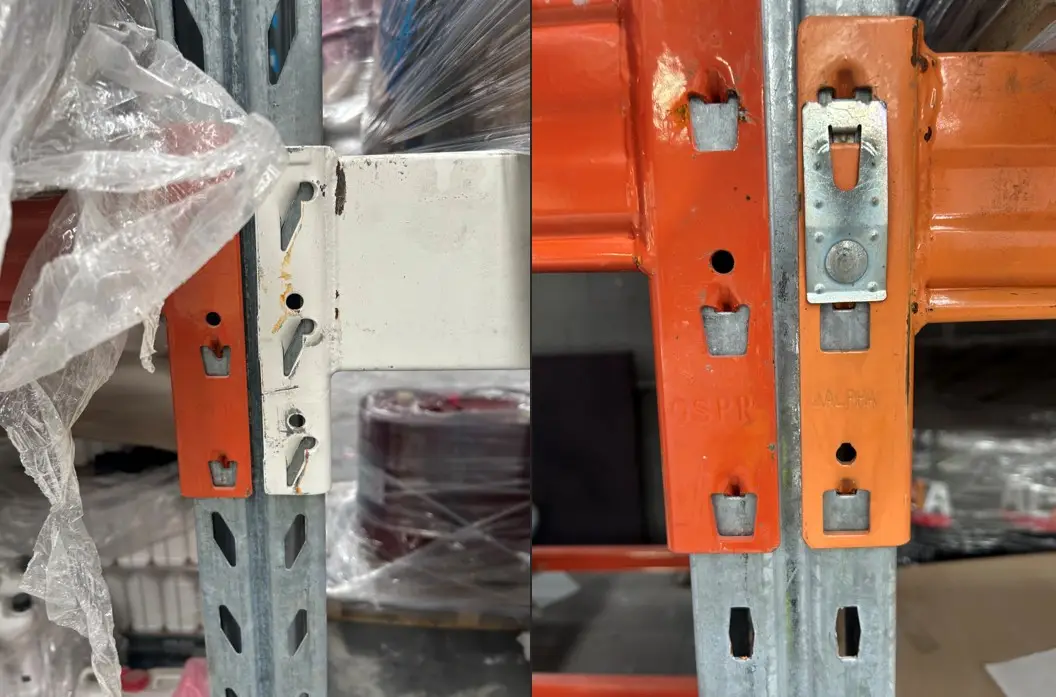
Why “Near Enough” Isn’t Safe Enough
When budgets are tight or you’re expanding quickly, it’s tempting to “make do” by plugging a few second-hand beams into your existing frames or grabbing some “compatible” uprights from another brand.
If the hooks fit the holes, it must be fine… right?
Not necessarily.
Pallet racking is an engineered system designed and certified as a whole – frames, beams, connectors, bracing, baseplates and anchors all working together under AS 4084:2023 (Steel Storage Racking). Industry.gov.au
When you mix brands, you’re gambling with three things that are invisible from the ground:
-
Connector geometry – the exact shape and engagement of the hooks
-
Hole pitch – the spacing and pattern of upright perforations
-
Tolerances – the small dimensional and installation allowances the system is designed around
Get those wrong, and the racking may still “stand up”, but its true capacity, behaviour under impact and compliance with AS 4084 can no longer be guaranteed.
Pallet Racking Is an Engineered System – Not a Mix-and-Match Kit
Every reputable pallet racking manufacturer designs their system as a complete structure:
-
Upright posts with a specific profile and steel grade
-
Bracing configuration and spacing
-
Beam section, connector design and locking devices
-
Baseplates and floor fixings
-
Tested load capacities and deflection limits
Technical manuals show, for example, uprights with diamond-shaped perforations at fixed vertical centres (often 75 mm) and defined frame depth tolerances of only a few millimetres.
AS 4084 requires that racking is installed, used and maintained in line with the manufacturer’s design and supplied load application drawings. Mixing components from different brands – even if they appear similar – is treated as an unapproved modification.
For CEOs and warehouse leaders, that has three immediate implications:
-
The published load ratings may no longer be valid
-
The installation may be non-compliant with AS 4084:2023 and WHS duties
-
Insurers and auditors may question cover if there is a collapse involving mixed components
Connector Geometry: When Hooks Don’t Share the Same Shape
At a glance, most pallet racking connectors look “close enough” – multiple hooks, a safety clip and a face plate. But the geometry varies significantly between brands:
-
Number of hooks (3, 4 or 5)
-
Hook spacing (vertical and horizontal)
-
Hook thickness and profile
-
How deeply the hook seats into the upright slot
-
The bearing area where loads are transferred into the upright
When you insert a beam from Brand A into an upright from Brand B, you can encounter:
-
Partial hook engagement – hooks not fully bearing on the upright
-
Gapping between connector and upright face
-
Misaligned safety locks – clips that don’t sit correctly or can’t be installed
-
Uneven load transfer – some hooks working harder than others
Under AS 4084, connectors must not show visible permanent deformation or cracked welds, and beam deflection is tightly limited. If the connector was never tested with that upright, you’re essentially running an unproven joint at every beam level.
From the ground, it might look fine. Under load, it’s a different story.
Hole Pitch & Perforation Patterns: 50, 75 or 76.2 mm Is Not “Close Enough”
Upright perforations are not universal. Around the world (and in Australia) you’ll see systems with:
-
50 mm pitch – common in European-style racking
-
50.8 mm (2 inch) pitch – typical in teardrop systems and some US-derived designs
-
75–76.2 mm (3 inch) pitch – widely used in Australian diamond-hole style racks
-
Other proprietary patterns, often with double rows of diamond or keyhole shapes
SSI Schaefer-style uprights, for example, are punched with square type slots at 50 mm centres to match their own bracket and beam connector geometry.
When you mix:
-
A 50 mm-pitch beam with a 75 mm-pitch upright
-
A 76.2 mm connector into a 75 mm hole pattern
-
Different hole shapes (diamond, keyhole, teardrop)
you can end up with:
-
Twisted beams – because the hooks can’t seat evenly in mis-matched holes
-
Out-of-level beam heights – affecting pallet clearances and forklift mast movement
-
Unintended eccentric loading – changing how the frame and beams are stressed
Those small differences in pitch – 1.2 mm or 25 mm – might sound minor. Across multiple levels and bays, they translate into millions of load cycles on connections that were never tested together.
Tolerances: The Millimetres That Keep Your Warehouse Safe
Beyond nominal dimensions, pallet racking has tight tolerances for:
-
Frame depth and upright straightness
-
Beam length and deflection under load
-
Bracing spacing and alignment
-
Overall out-of-plumb and out-of-straight for installed racks
AS 4084 and related guidance set limits such as:
-
Out-of-plumb – racking can only lean by a small ratio before it must be assessed
-
Beam deflection – vertical and horizontal limits relative to beam span
-
Connector condition – no visible permanent deformation or cracked welds
When you mix brands, those carefully calculated tolerances are no longer valid. You may still be “within the AS 4084 tolerance box” for one brand, but outside it for the hybrid structure you’ve unknowingly created.
What Actually Goes Wrong When You Mix Brands?
1. Reduced Load Capacity – Without Any Visible Warning
Load ratings are based on full-scale testing of that manufacturer’s beams in that manufacturer’s uprights, with specific connector geometry and hole pitch.
Swap in a different beam or upright and you may:
-
Reduce the vertical capacity of the beam connector
-
Change the way forces transfer into the upright (bending, shear, local bearing)
-
Increase stress at welds and hook roots
The rack may not collapse immediately. Instead, it can develop:
-
Increasing beam deflection over time
-
Deformed or “opened up” connector hooks
-
Cracks around welds and perforations
From the ground, all you may see is a slightly sagging beam – until something lets go.
2. Non-Compliance With AS 4084:2023 and WHS Obligations
AS 4084:2023 and state-based guidance (SafeWork NSW, WorkSafe Tasmania, universities and ports authorities) all emphasise:
-
Racking must be installed and used as per the manufacturer’s specifications
-
Any changes to configuration require engineering review
-
Systems must be regularly inspected, at least annually, by a competent person
Independent inspection providers explicitly list “mixing and matching parts from different brands or suppliers” as an unapproved modification that makes the system non-compliant with AS 4084:2023.
If there is an incident, investigators and insurers will look closely at:
-
Whether components match the original design
-
Whether load signage was still correct for the mixed system
-
Whether modified areas were identified in inspection reports
3. Inspection, Signage and Documentation Don’t Match Reality
AS 4084 and WHS guidelines require:
-
Load signs showing maximum unit load and bay capacity
-
Current technical drawings reflecting the actual configuration
-
Documented inspections every 12 months (minimum)
Once you start mixing brands:
-
Existing load signs are no longer reliable
-
Technical drawings no longer match what’s installed
-
Inspectors may mark mixed areas as amber or red risk until they’re engineered or rectified
That means more remedial work, more downtime and more paperwork for your team.
Common Mixing Scenarios We See in Australian Warehouses
In practice, mixing often creeps in over time rather than through one big decision:
-
“Compatible” replacement beams
-
A supplier offers beams “compatible with SSI/Dexion/Colby/etc.”
-
They fit the upright, but their connector geometry and steel grade are different from the original system.
-
-
Second-hand bargains
-
A bay or two of second-hand racking is added to an existing run.
-
To “keep it tidy”, the installer connects new and old frames with shared beams or bracing.
-
-
Ad-hoc repairs after impact damage
-
A single damaged frame or beam is replaced with “whatever the repairer had on the truck”.
-
The rest of the bay remains original, creating a hybrid structure.
-
-
Add-ons during expansion
-
New bays are added onto old ones using a different brand because that’s what’s currently in stock.
-
Splices, bracing and run continuity no longer follow a tested design.
-
Each of these scenarios undermines the very thing your board expects – a safe, compliant, certifiable storage system that protects people, product and equipment.
How CEOs and Warehouse Managers Can Spot Mixed Racking
You don’t need to be an engineer to identify potential issues. Walk your warehouse and look for:
-
Different upright shapes in the same run (face profiles, hole shapes or colours)
-
Beams with different connector plates or hook patterns sharing the same upright
-
Safety clips that don’t sit flat or have obviously different designs
-
Load signs that mention a different brand to what you can see installed
-
Unlabelled or “DIY” repairs such as additional brackets, bolts or plates
If you spot any of these, it’s time for a formal review under AS 4084:2023 – not just a visual tick-and-flick.
Safer Alternatives to Mixing Brands
Instead of plugging whatever fits into the nearest upright, there are safer paths that still control cost and downtime:
1. Engineer-Approved Component Substitution
In some cases, it may be possible to substitute components, but only after:
-
A structural engineer or the original manufacturer checks the compatibility
-
New load capacities are calculated
-
Updated drawings and load signs are issued
This turns a “near enough” mix into a documented, engineered solution.
2. Like-for-Like Repairs and Extensions
For repairs and small extensions, insist on:
-
Genuine, like-for-like replacement parts from the original brand
-
Matching hole pitch, connector geometry, frame depth and upright profile
-
Updated documentation showing the new configuration
This keeps your racking within the original tested system.
3. Designed System Upgrades and Consolidation
If you’ve accumulated a patchwork of brands over the years, it may be more cost-effective in the long term to:
-
Consolidate into a single, engineered system with known load ratings
-
Re-purpose or trade in surplus components where appropriate
-
Re-layout the warehouse to improve capacity and efficiency at the same time
A full redesign can often unlock more pallet positions and smoother workflows than a series of piecemeal fixes.
How Better Storage Systems Helps You Stay Compliant and Productive
Better Storage Systems designs, supplies and installs industrial pallet racking solutions right across Australia, with experience in selective, drive-in, double-deep, cantilever, VNA and other specialist systems.
Key ways we support CEOs and warehouse teams:
-
End-to-end design and quotation
-
Concept layouts, capacity modelling and compliance with AS 4084:2023
-
-
Pallet racking installations and relocations
-
Professional installation and reconfiguration using matched, engineered components
-
-
Racking safety audits and repairs
-
Formal inspections, damage assessments and rectification plans aligned with AS 4084 and WHS guidance
-
-
New and used pallet racking
-
Supply of quality new systems and carefully selected used racking, configured as complete, compatible solutions – not a random mix of components.betterstorage.com.au+1
-
For leadership teams, that means:
-
Clear, defensible compliance with current standards
-
Accurate load signage and documentation
-
Fewer surprises at audit or insurance renewal time
A Practical Checklist for Decision Makers
Before you approve the next repair, expansion or second-hand purchase, ask:
-
Are we mixing brands, or staying within one engineered system?
-
Do we know the hole pitch, connector type and tolerances we’re dealing with?
-
Will this change keep us compliant with AS 4084:2023 and our WHS obligations?
-
Have we updated drawings, load signs and maintenance records to match?
-
Has a competent person – engineer or specialist racking provider – signed off on the change?
If the answer to any of these is “no” or “not sure”, it’s time to pause and get expert advice before the first pallet is loaded.